

Future of Preservation Manifesto
How can preservation maintain relevance to future generations?
All places are dynamic and living things. Our built environment is both witness and proof to history. The act of preservation is a necessity in maintaining the memory and authenticity of this record. The idea of preservation began in the late 18th century to preserve 2,000 year-old monuments.
Through the last century, the preservation movement has expanded its reach significantly: from monument to building to streetscape to landscape to urban sectors to government policy to tax incentives; everything is now potentially susceptible to preservation. With this environmental and cultural expansion comes exponential complexity and great responsibility, yet its curatorial principles remain overly simplistic. Concurrently with this expansion, the movement has embraced an increasing number of value propositions to rationalize its aims, yet its accepted outcomes remain singular in encapsulating our past. But all places and buildings have a continuing history; they are used, damaged, repaired, and bear the markings of actions and events throughout time. As modern culture moves forward, our environment expands, is re-inhabited, and is altered with invention. The 20th century in America yielded a great expansion in our built environment, much of it now coming due for renovation.
The U.S. Department of Energy estimates that 17% (52 billion square feet) of our current building stock will face the prospect of demolition over the next 30 years, and half will be renovated. Today, America’s built environment faces a new challenge of ecological sustainability. This leaves the idea of preservation in a precarious state. To continuously encapsulate our built environment through the act of preservation is counter-productive; we face increasing risk of endangering invention and even forgetting the intentions of history. If we are to live with our history while embracing our future, we must rethink the very idea and standards of preservation. Ultimately, the act of preserving a thing in its original condition isn’t always the best solution nor is its full erasure from our memory. There are unexplored degrees of preservation between its ever-present all-or-nothing proposition. As preservation has embraced multiple value rationales, it must too embrace multiple outcomes. Preservation is often viewed antagonistically by developers in their efforts to modify properties, but it has the potential to become the catalyst for shaping vibrant and healthier communities.
For preservation to maintain relevance through future generations it must:
Embrace outcomes beyond the curatorial.
Embrace overlapping histories beyond the physical artifact in its regulations.
Embrace technology and the human needs of the day.
Embrace new architecture with the authenticity of artifact.
Define varied levels of significance with varied standards.
H I G H L I G H T S
• NTHP JetModern by Seth Tinkham
• The Architect’s Newspaper, Preservation is a Moving Target
• The Fate of Cyclorama as National Implications, UrbDezine Magazine

Old South Market
How do we activate one of Boston’s busiest street corners while preserving the integrity of one of America’s most preeminent landmarks?
Since the 1773 mass protest meetings that led to the Boston Tea Party, Old South Meeting House has served as a gathering place for discussion and celebration and a haven for free speech.
The museum has rented the street corner to various market stands over the years as a source of income. The new market enclosure will bring a new sense of transparency to the corner of this historic building and better activate this pedestrian center in the downtown crossing district. The structure is designed to be free standing with no attachment to the historic building. For the market vendor it will provide a new security enclosure and better visibility and interior organization.

North End Infill Apartments
How can an urban infill project assimilate into the historic Boston context while simultaneously differentiating itself as a unique living experience?
Located in the historic Downtown of Boston, this 4 unit multifamily infill building establishes itself as the missing link in the surrounding urban fabric. The contemporary insertion mimics it’s neighbors in height, window alignments, and color tone. A weathering steel skin differentiates the building and imbues it with a contemporary flare all the while maintaining the rich warm red coloring of its surroundings. The thickened façade responds to the program behind it: the retail ground floor offers ample glazing, while the next floor above offers privacy for residents with tall and narrow windows. With each successive level from the street, wider windows are provided. A mechanical parking system, accessed from the rear alley, provides each unit with one parking space, a highly sought-after commodity in the city.
H I G H L I G H T S
• Weathering Steel Facade
• Mechanical Parking System
• Ground Floor Retail

Overlapping Histories
How do we create urban furniture with a collective identity while maximizing flexibility for arrangements and vendors?
Too often preservation is a curatorial act focused solely on the physical building and not the ideas and stories that shaped it over time. New architecture can have a dialogue with old architecture to evoke story, memory, and solidify identity and meaning. Doing so reveals deeper meanings and heightens awareness of history. This approach can be realized in five key phases:
1. TRACING TIME: Move beyond the physical building to uncover the ideas, stories, and events that first brought it about. This approach can move buildings beyond it’s “a good example of…” to it’s “directly connected too the story of…”
2. UNCOVERING THEMES: By mapping overlapping historic influences such as the construction methods, the occupants, the architect, the neighborhood, the economy, the cultural influences, and the news of the day, we can compare and uncover the unique threads and themes.
3. STRATEGIZING APPROACH: Based on historic significance, regulations, and project goals, define the intent: should the building be fully preserved, an archeologically interpreted site, partially preserved, transformed, minimally preserved, or some hybrid approach?
4. CONCEPTUALIZING DESIGN: The rehabilitation, renovation, alterations, or additions are born out of the findings such that they help to activate and heighten the awareness of the building’s overlapping historic influences.
5. CRAFTING THE DETAILS: Careful detailing between old and new elements can heighten awareness, and integrated graphics can support the story.

Garty Family Rowing Pavilion
How can we shape a building with light and water to create a vibrant social experience?
On a limited bay front site, the Garty Family Rowing Pavilion was designed to honor the competitive history and celebrate the future of the San Diego Rowing Club. The pavilion contains a century’s worth of artifacts and acts as an event space for parties and other social events. The building references the old craft of boat-building and the sleek lines of contemporary rowing shells. Defining the main event space, the elongated hull-shaped ceiling is held away from the walls to reveal the sky, exhaust heat through operable skylights and allow daylight to penetrate the space.
Chris Johns served as the Project Designer and Manager while working for ARCHITECTS hanna Gabriel wells.
H I G H L I G H T S
• AIA San Diego Design Award | Citation
• San Diego Architectural Foundation | Orchid Award

Hingham Condos
Once the site of World War II naval shipbuilding, the redevelopment of the Hingham Shipyard presented an opportunity to explore the intersection of past and present through three condominium buildings.
These buildings, located within a new mixed-use development of retail and parks, position themselves at the water’s edge, capturing views and creating a visual backdrop to the boat-filled marina they overlook. Material cues are taken from the metal-plated hulls of WWII naval ships, the clapboard hulls and mahogany trim of old sailboats, and the brickwork of former industrial buildings. This contextual palette creates a dialogue between building and boat; materials visually organize the building facades with rhythms following the marina docks and patterns reminiscent of ship hulls. Each of the 92 living units is individually connected to the landscape, water, boats, and sunsets of the shipyard.
Jason Hart served as the Project Architect and Manager while working for DiMella Shaffer.
C O L L A B O R A T O R S
L.A. Fuess Partners | RDK Engineers | Building Envelope Technologies | Collective Wisdom Corporation | Robert Benson Photography

Summerfield Meeting Hall
How can a historic general store tell the stories of a small town while serving as its new municipal meeting hall?
The Town of Summerfield plans to renovate their signature historic property, the Gordon Hardware Store, for use as its public meeting hall. The building, largely vacant since the 1950s, would house a grand meeting hall with an addition for supporting functions. We engaged stakeholders to assess their needs and define the building’s history.
In its day the general hardware store was the social crossroads of this rural area - providing both necessary goods and daily conversations. Its reactivation would once again allow the citizenry to gather for town meetings and other events. The new supporting addition also adds flexibility for activities, and graphically displays the building’s social history through photographs and storytelling. These displays and the reuse of this building will preserve the cultural history of Summerfield for future generations.
H I G H L I G H T S
• Historic research and interviews
• Programming and needs assessment
•Cost estimating
C O L L A B O R A T O R S
Lynch Mykins | Surface678 | AME Consulting Engineers | Cumming Corporation

Downtown Hotel
The design of this speculative development responds to the context of a vibrant downtown neighborhood with a high-rise building that nestles into the large infill lot with a strong presence.
Our charge was to design a building that complied with allowable zoning regulations and maximized value for the site. We explored a mix of various uses that would combine to shape the building’s form, activate the street and result in a dynamic structure that would recall the past with a contemporary sense of permanence. The building design responds to the context with significant retail and commercial opportunities on the first two levels which are pulled in from the property line to create a double height arcade along the street. The remaining upper levels of the building provide a boutique hotel with a sky-lobby, indoor amenity spaces, and various outdoor terraces. The modularity of the façade expresses the cellular nature of the stacked hotel rooms and is carried out down to the articulation of bricks.
H I G H L I G H T S
• Thin composite steel-concrete floor system to achieve shallow floor-to-floor heights.
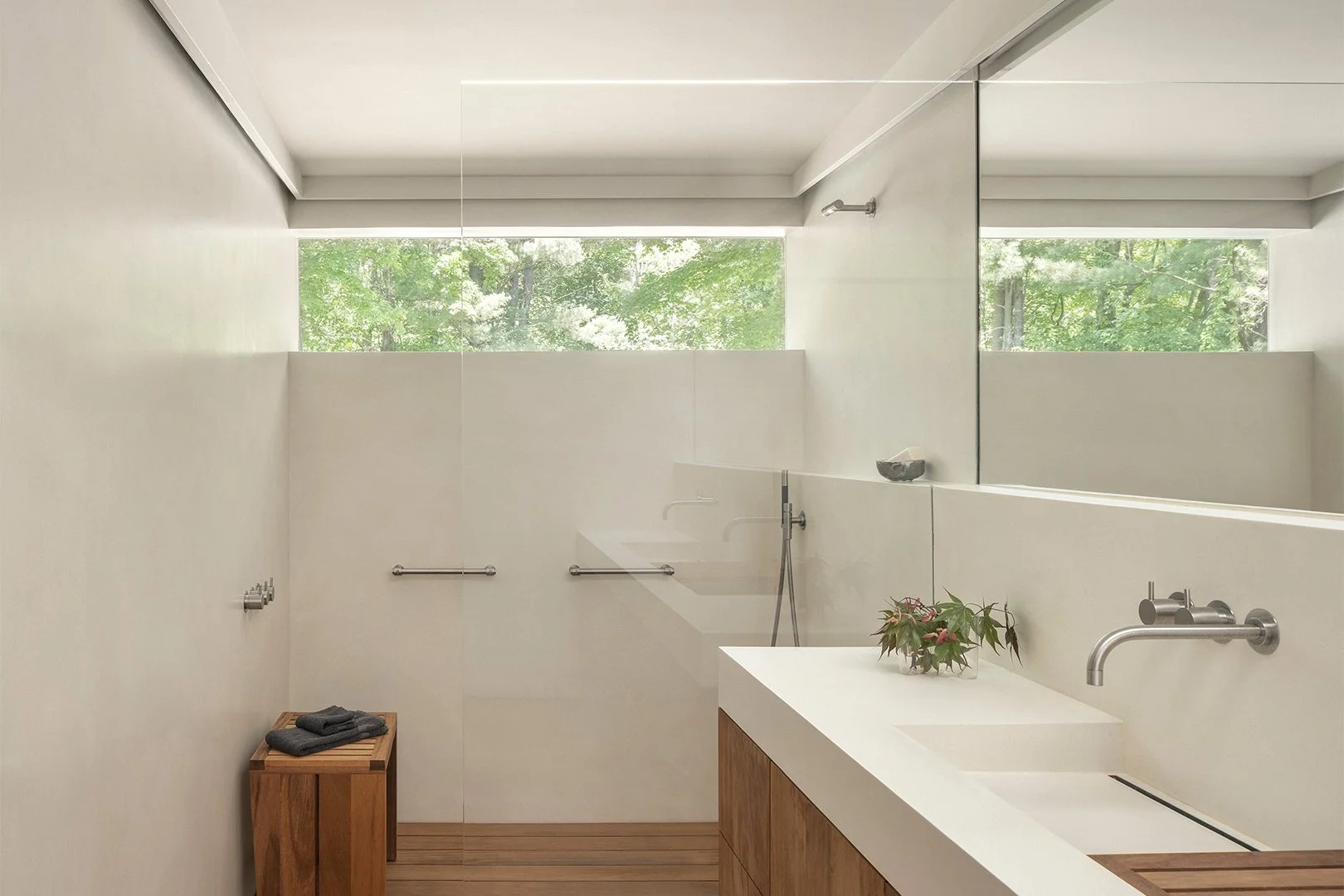
Sasaki House Bathrooms
This home is perched on the land overlooking a wooded lot. It revolves around the warmth of wood and the glow of light to organize the many retirement hobbies of the owners. The spaces are knitted together with a wood wall that moves from the porch, through the living room, entry, kitchen, and up the stairs. Two-story lightwells pull daylight from above, producing a soft glow in the kitchen and master bath. The roofline follows the slope of the land, allowing a workshop below the master suite on one end, and hobby rooms (art, yoga, music) above the garage on the other end.

White Residence
Can we compliment and contrast at the same time?
We honed in on three distinct aspects of the dense pine trees that make up this building site: ground, movement, and above. The GROUND is a thick mat of pine needles on gently sloping land; walking on them is very quite sound. The home is sliced into the land at one end while hovering slightly above at the other with garden and deck walkout areas.
The layout of the home meanders; drawing out an experience of MOVEMENT through spaces and views akin to moving around the Pines. ABOVE, a thick sculpted roof shapes interior spaces and floods the home with filter light through the high canopy of the pine trees. While the experience of the home compliments its place, the varied yellow exterior gives a modern pop contrast to an otherwise very brown and dark green natural environment below the treetops. Bespoke details throughout make for a warm modern home with a dash of playful fun.

Liberty Warehouse
Built in 1940, Liberty is Durham’s last remaining tobacco auction warehouse
The design integrates the Liberty brick facade at the corner of Rigsbee and Corporation into the new commercial and multi-family housing development. The historic facade is maintained and the new architecture takes visual cues to assimilate window patterns, locate entries, and program the corner with a restaurant. Fiber cement siding by Oko-skin provides a warm durable exterior that compliments the historic brick.
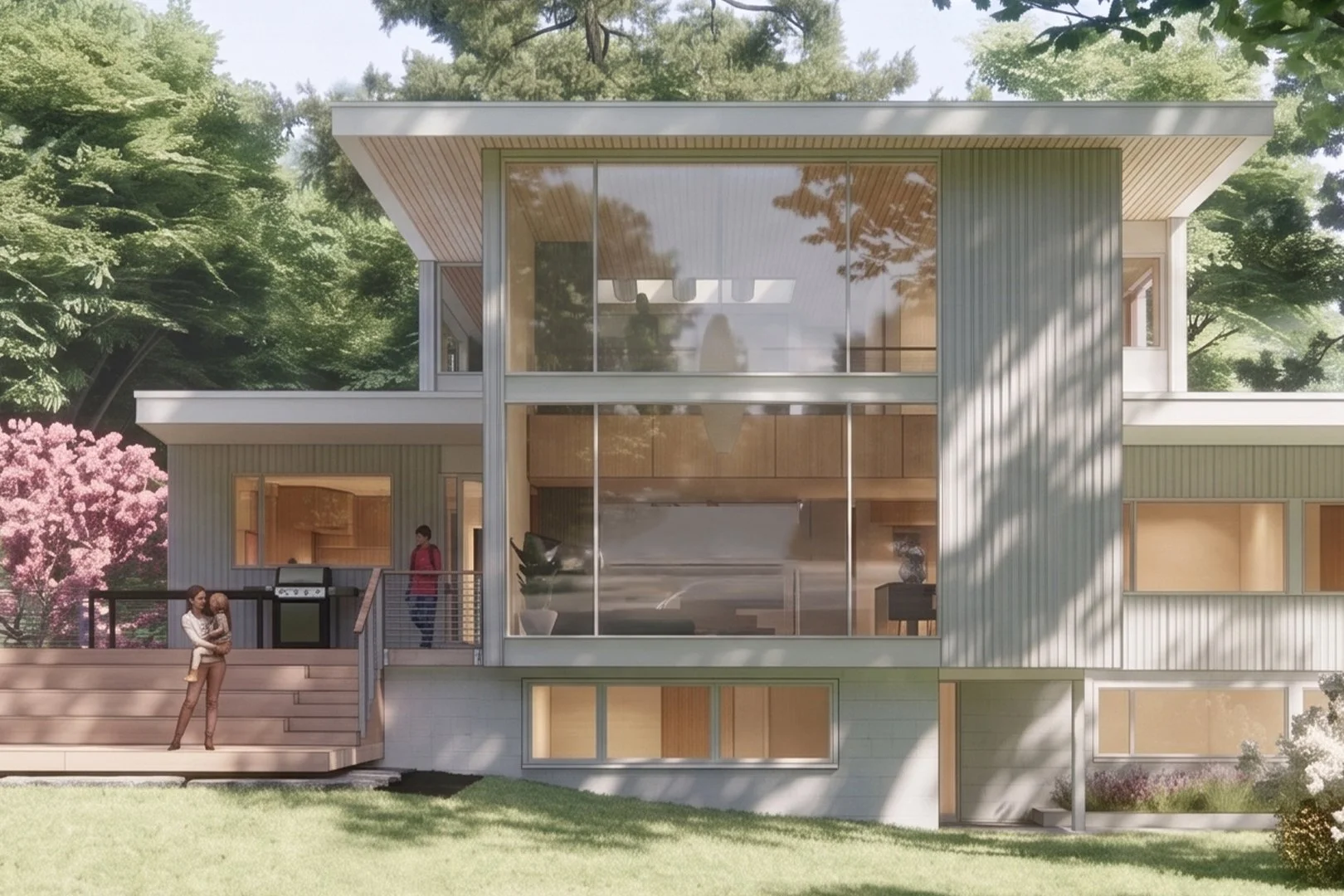

Raleigh Residence
How can a home be private and flooded with natural daylight?
The Raleigh Residence is a two-story contemporary home nestled on a steeply sloping site and closely surrounded on three sides by neighbors. Wall, movement, light, and envelope were shaped to create a simultaneously warm but private residence, while still maintaining connection to the site.
The residence is characterized by a delicately skinned living volume lightly resting on heavy masonry walls. The main living spaces are open and directly connected to the landscaped interior courtyard via full height windows that run along the length of the residence - creating a sense of private sanctuary on an otherwise hemmed in site. Movement from outside to inside and through the home is defined by warm wood elements weaving throughout the house. The expansive window wall is then shaded with the same wood slats, extending from the interior wood-wrapped staircase. While on the stair landing, residents experience the courtyard from the unique view of a worm.

Metal & Light
How can heavy metal become visually light and airy?
This retail center just west of downtown had not been renovated since it was constructed in the 1970s. New ownership desired a fresh public appeal for both potential tenants and customers.
As a budget conscious project, we choose to make necessary repairs and focus the majority of funds on adding a new metal marquee along the front. Our challenge was to create a fresh, light and airy feel. We did this through the interplay of perforated metal and light. The existing facade is painted as a backdrop with new perforated metal panels positioned in front. Different hole sizes are used for the perforation to vary the opacity. This allows sunlight through and the ability to see sky, trees, and layers behind - all are carefully detailed and choreographed. Custom steel frames bound each four foot panel and are hung off the building with structural steel. The ability to see through the perforated metal creates a fresh, light and airy feel to the plaza while providing a unique identity and branding opportunity.
H I G H L I G H T S
• Perforated metal panels, steel structure, and phenolic resin slats
C O L L A B O R A T O R S
Lynch Mykins | Engineered Designs | Wilson Covington Construction | Design Element Signs

Tiny Home Community
The goal of this project is to create a new typology for urban housing that helps address the problem of homelessness in urban centers by providing a stable dwelling place for those coming out of homelessness. Community is fostered through common activities and interactions that build and strengthen personal relationships.
The project provides a core space to foster these relationships and an adaptable framework as community grows and contracts. 12 prefabricated dwelling modules are arranged adjacent to one another to form a central community porch. From street side this gives the appearance of a human-scaled urban building, rather than loosely organized mobile dwellings. The community porch is centralized to increase resident interactions, provide visual and sound connections, and create a sense of safety. A simple wood trellis roof with clear plastic covers the dwellings and community porch like an umbrella. Rainwater is collected from the roof and stored in an underground cistern where it’s used to flush toilets and water the garden. The umbrella roof reduces heat gain from the sun and keeps the rain and snow off the dwelling units. This increases the energy efficiency of the dwellings and extends their lifespan. The trellis and units may be added to or subtracted from as necessary to accommodate the residents.
H I G H L I G H T S
• 144 sf prefabricated dwelling modules
• Rainwater collection
• Sustainable site strategies
• Flexibility for expansion and adjustment
• Communal gardens
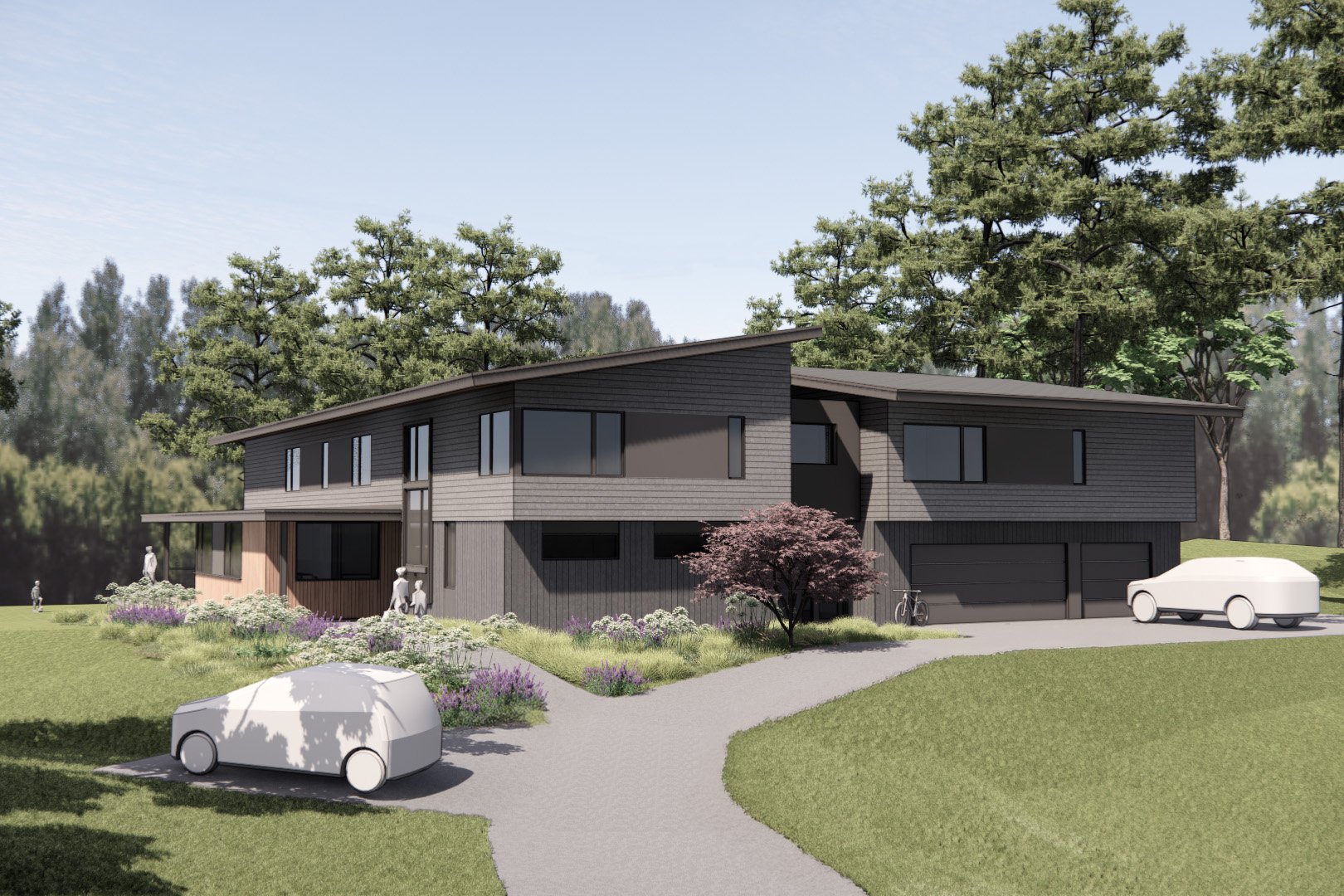
Concord Residence
Movement through the home is a journey through nature, engaging both sides of the site and pulling inhabitants into the landscape. Rooted in mid-century modern and deck house traditions, the architecture uses horizontality, transparency, and outdoor living to strengthen this connection to place.

Trott Residence
How can we weave together the space of home with community in a historic neighborhood?
With a view of the Durham skyline, this home sits on a corner in the historic Cleveland-Holloway neighborhood. Mediating between the public street and a private courtyard, it spills out in both directions.
A deep front porch continues the existing pattern of porches along the street and seamlessly extends the inside to the outside through a series of foldaway glass walls. Thermally modified wood slats weave the siding, railings, fences, and trellises together, creating dynamic patterns of light and shadow. The house and site are designed as one; weaving together inside and outside, building and nature, old and new. This home features a green roof and a 10kW solar array.
C O L L A B O R A T O R S
Tina Govan, AIA | Bob Wuopio, Contractor | Lysaght Structural Engineers | Laura Moore Landscape Architect | Mark Herboth Photography

The Adapter
How do we design a flexible urban space that encourages community participation?
Kendall Square has become as mecca for companies making tremendous advancements in technology and science but the recent commercial development has followed the status quo. This project proposes to play a unique role of enlivening a dead zone in the urban fabric by establishing an adaptable urban event space and an adaptable light filter to create opportunities day and night for organized events or low-key spontaneous gatherings. It is formed by two parts that establish its identity in the urban fabric. The ground level adaptable urban event space is defined by large bi-fold and swing doors that allow the Adapter to fully open up providing for a multitude of programmatic options. The upper section is an adaptable light filter made up of periscopes to choreograph the seasonal southern daylight, project light and graphics at night, and provide unique views into and out of the Adapter. The space is a brand, it stimulates interactive experiences and encourage users to observe space, light and material in unanticipated ways through its extreme adaptability.
H I G H L I G H T S
• Adaptive reuse of an underutilized MBTA utility space
• Flexible furniture components such as stages, bleachers, service counters, bike rack bartops, and display shelves adapt to various programmatic uses.
• Use of bi-fold hanger type doors.

Taylor-Metcalf Additon
How can the experience of moving through a home enhance your connection with the nature outside of it?
The design for the Phase 1 addition emerges as a response to the nuances of the site. On one hand, there is a need for a relationship between the master suite addition and the nondescript existing house. The existing house is conventionally clad in stucco and penetrated by generic windows.
The addition mimics this idea as an autonomously clad enclosure of raw steel punctured by windows that filter light, air, external views, and views to adjoining spaces. The Phase 2 addition is a bold mediator between the home and its complex natural surroundings. It features a double height living and dining room overlooking the gracious backyard poised at the head of a dynamic canyon landscape and large Brazilian pepper tree. The raw steel skin mediates between the front and back of the house by creating an overhang in the back yard for shade and an upper porch in the front yard.
H I G H L I G H T S
• ASID San Diego Design Excellence Award, 2nd Place, 2020
C O L L A B O R A T O R S
Ian Mellor | Vincent Designs, Inc. | Richardson Steel Inc. | California Sheet Metal | Studio 512 | K-CO | Arise Interiors

Mission Beach Residence
How can a home in one of the most densely populated beachfront communities feel both open and private at the same time?
The three-story residence is situated on a small corner lot bordered by pedestrian walks on the south and west. Natural ventilation, daylight and views are achieved by carving into the building’s mass. This process of choreographed subtraction provides a variety of spaces that connect to the surrounding context while maintaining privacy.
Open to the south, the courtyard defines the entry and provides daylight deep into the home’s spaces as the copper shingled walls articulate the movement of the sun. A reflecting pool reaches out from under a steel gate to lure visitors into the courtyard and up a delicately cantilevered staircase to the main residence. On the second level, the entertaining spaces open onto a large terrace overlooking the boardwalk, beach and ocean. Spaces become more intimate as one moves to the rear of the second level alluding to the private portions of the home. Access to the third or master suite level is subtly revealed behind a custom floor-to-ceiling storage and display cabinet. The master suite level includes the office, master bedroom, bath, closet and laundry. These spaces spill out onto outdoor terraces for distant views of the mountains, bay and ocean.
Chris Johns served as the Project Designer and Manager while working for ARCHITECTS hanna gabriel wells.
C O L L A B O R A T O R S
Mike Surprenant & Associates | Jamie Lievers Landscape | RGB Group, Inc. | Evanko Cabinetry | Vincent Designs, Inc. | Larry Stanley Photography | Studio 512